The Translator in the Footnote
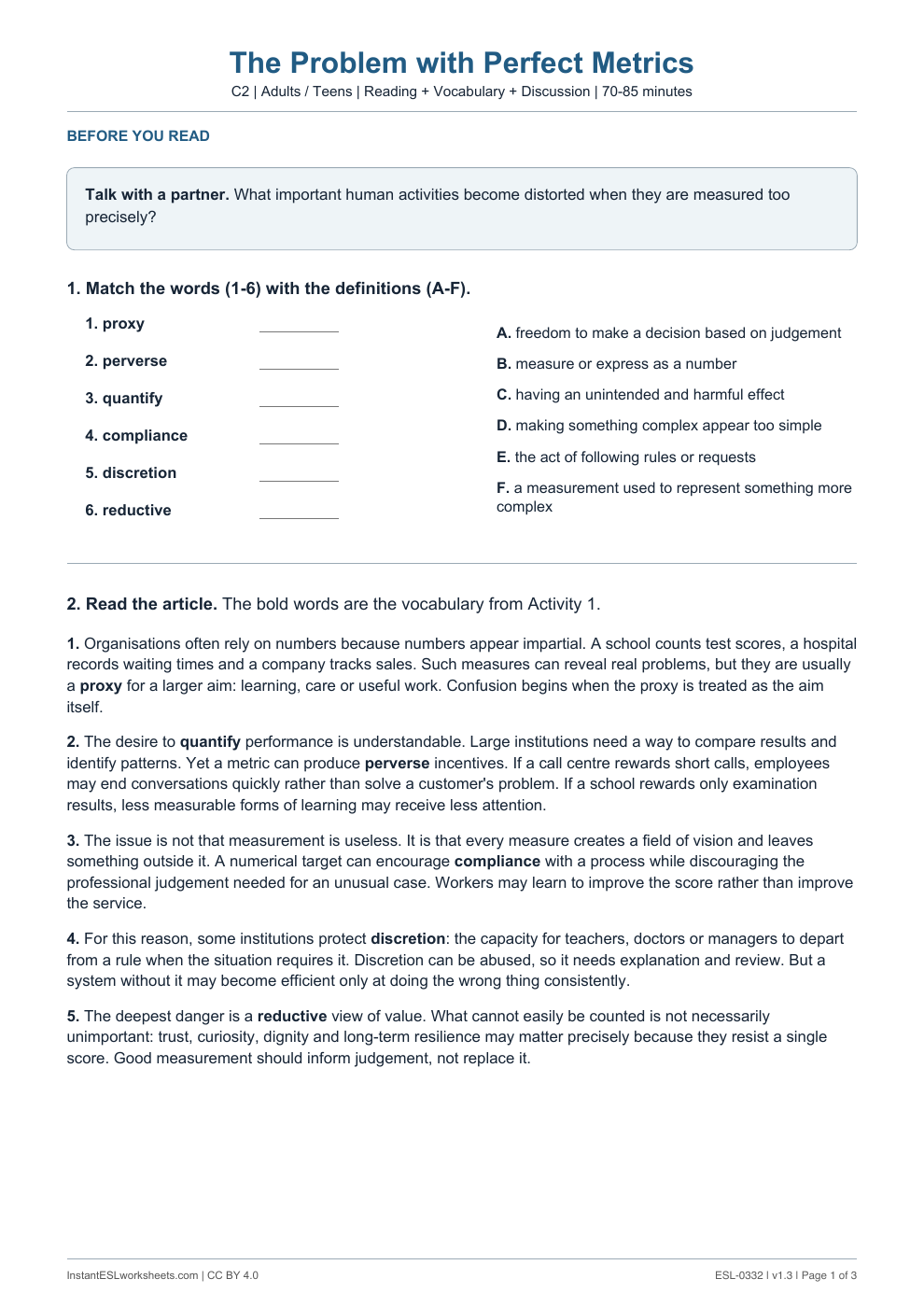
C2 reading: At the reading, someone congratulated the translator on making the novel sound as though it had been written in English. Includes vocabulary, six comprehension questions, discussion prompts and full-sentence answers.
What’s in the worksheet?
- 4 vocabulary explanations
- Six comprehension questions and two discussion prompts
- Separate full-sentence answer key and teaching notes
Explore why fluent translation is a real achievement but not a complete measure of fidelity. Social forms of address, ordinary dialogue and footnotes reveal decisions that a natural-sounding English version may make invisible.
Worksheet preview
Open PDF ↗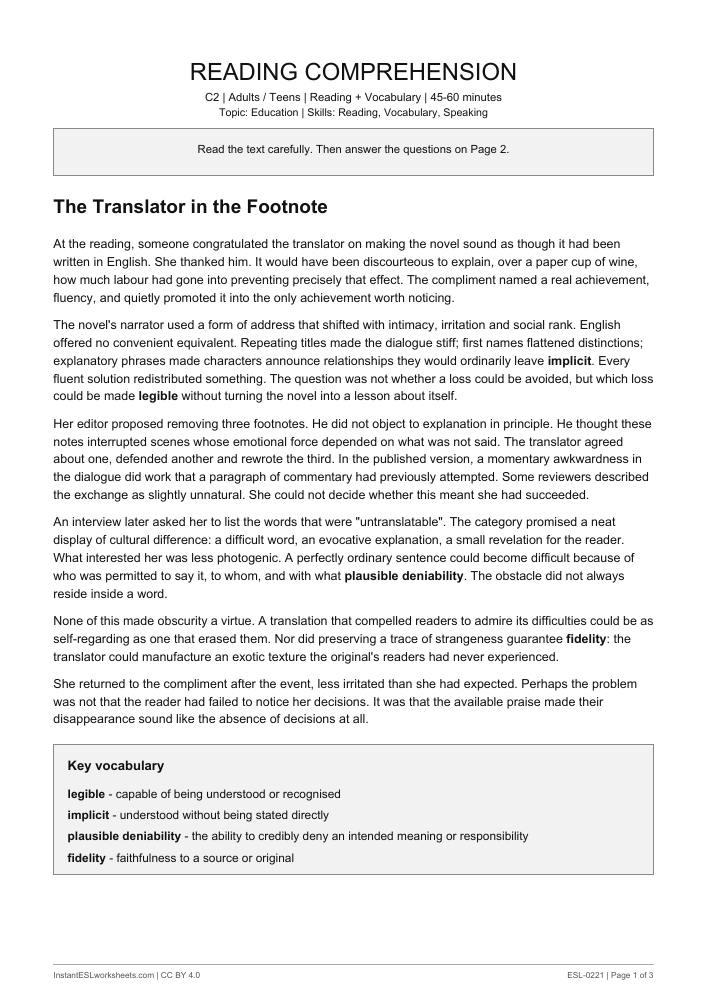
Page 1 of 3 · A4 printable PDF
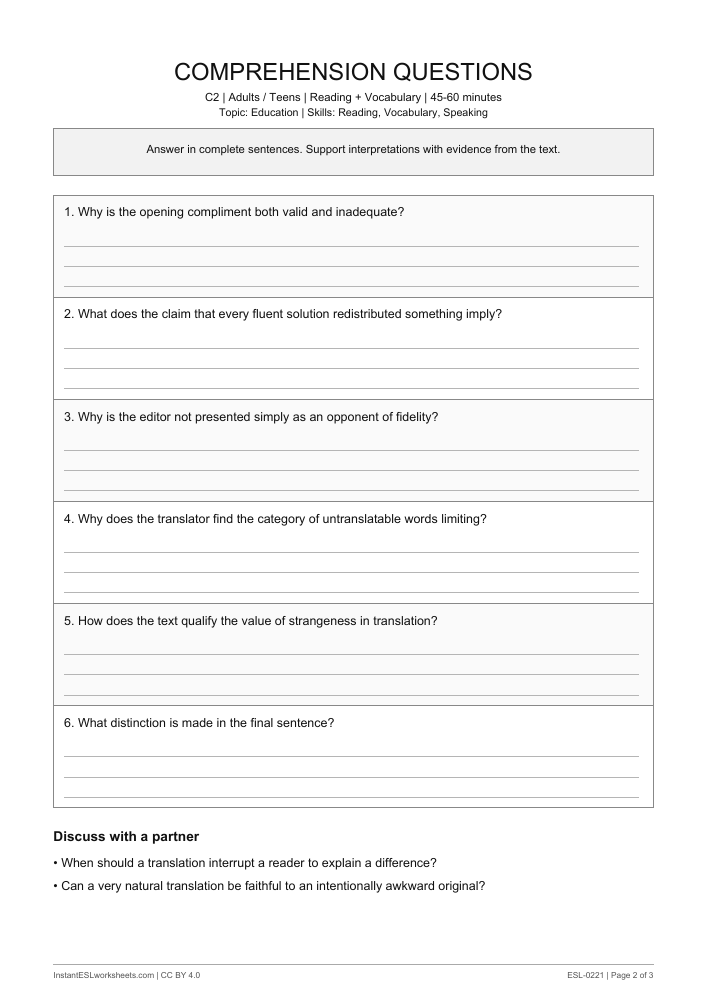
Page 2 of 3 · A4 printable PDF
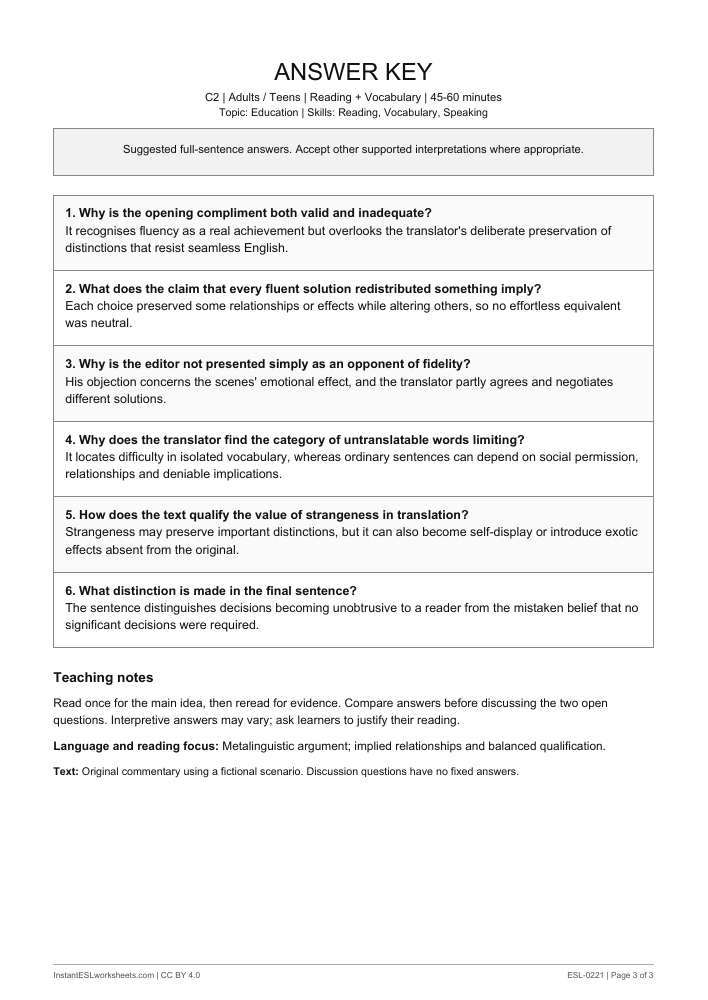
Page 3 of 3 · Answer key · A4 printable PDF
A simple way to teach it
Before the lesson
Use the reading, questions and suggested answers. Clarify legible, implicit, plausible deniability and fidelity. Knowledge of another language can help but is not required.
- Read the address example to identify what titles and first names redistribute. Consider why the editor's objection to explanation is reasonable.
- Answer the six questions, including why a single untranslatable word cannot represent all translation difficulties. Trace the qualification that strangeness does not automatically mean faithfulness.
- Compare supported readings, then discuss the final distinction between invisible decisions and an absence of decisions.
Support and extension
Support by linking each example to its argumentative role. Extend by comparing two imagined renderings of an address, explaining the social meaning gained or lost rather than declaring one universally correct.
Suggested approach. Adjust the pace and number of questions to suit your class.