The Case for an Unfinished Map
C1 reading: When the town archive invited residents to annotate a digital map, the organisers anticipated corrections: a street renamed, a demolished cinema located more precisely, a photograph assigned its proper date. Includes vocabulary, six comprehension questions, discussion prompts and full-sentence answers.
What’s in the worksheet?
- 4 vocabulary explanations
- Six comprehension questions and two discussion prompts
- Separate full-sentence answer key and teaching notes
Explore how a digital archive can acknowledge conflicting memories without treating every claim as equally established. The unfinished map distinguishes factual corrections, attributed recollections and unresolved claims.
Worksheet preview
Open PDF ↗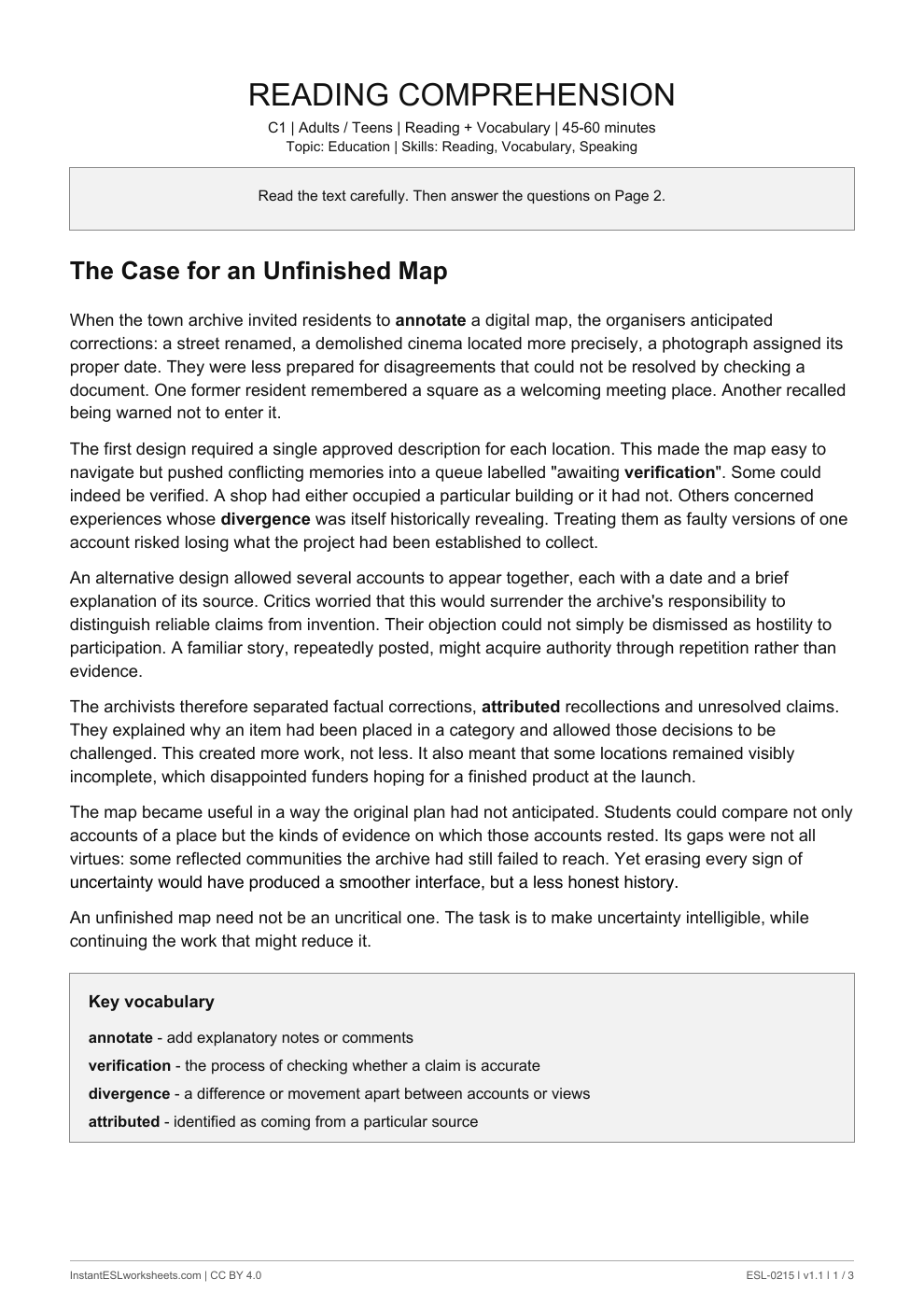
Page 1 of 3 · A4 printable PDF
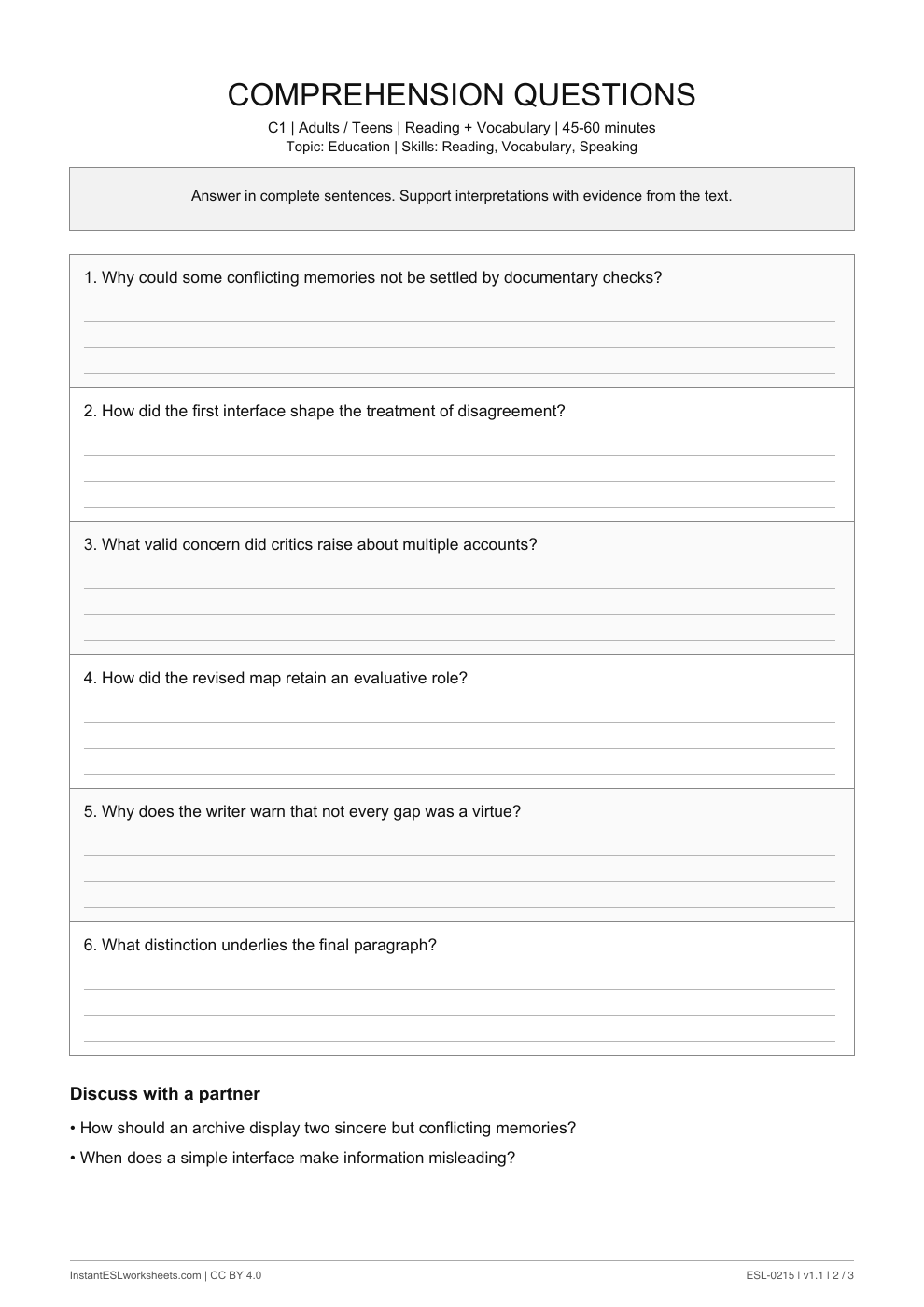
Page 2 of 3 · A4 printable PDF
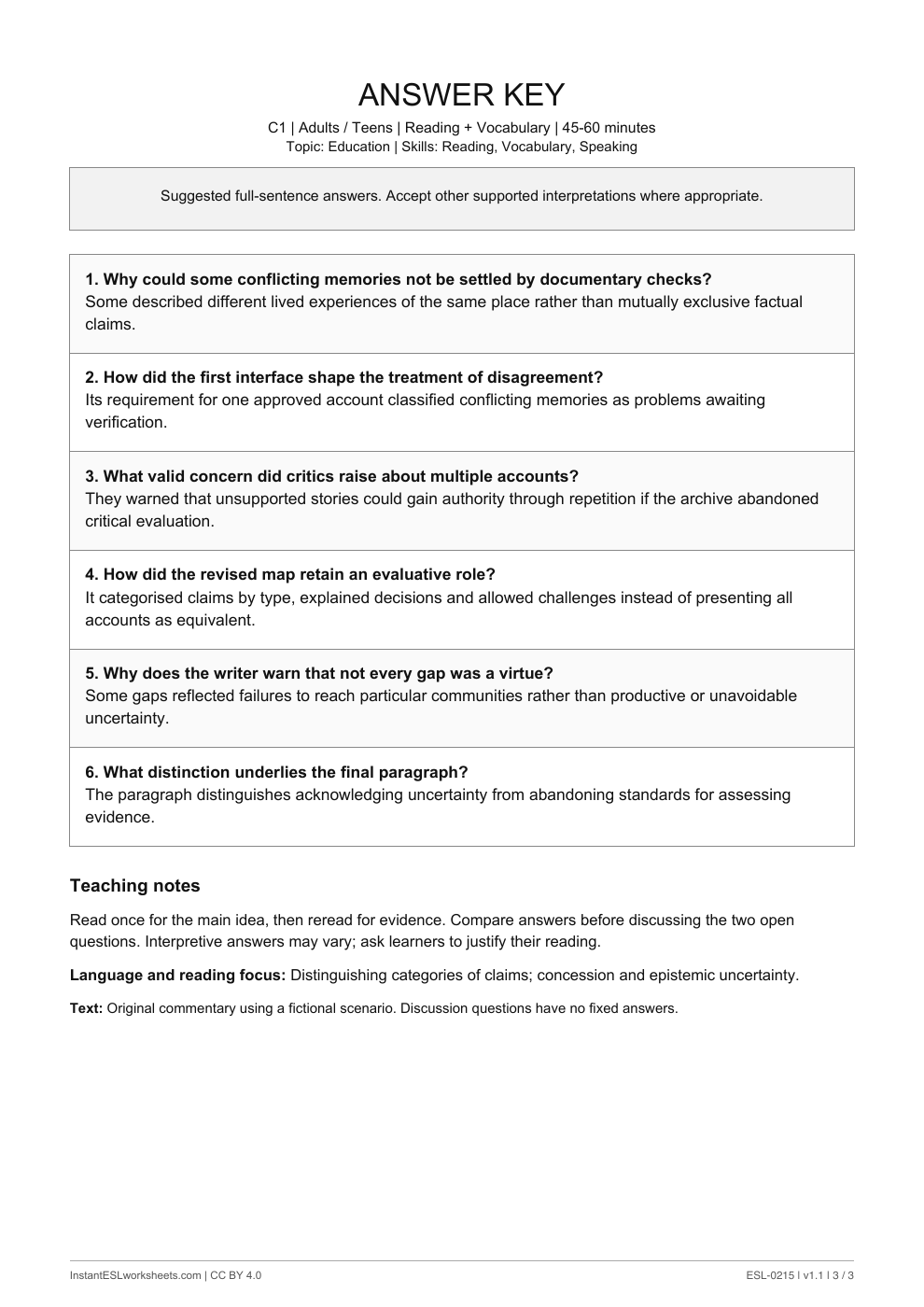
Page 3 of 3 · Answer key · A4 printable PDF
A simple way to teach it
Before the lesson
Prepare all three pages, with suggested answers reserved. Clarify annotate, verification, divergence and attributed; learners need not resolve a real historical dispute.
- Read for why residents' accounts exceed the organisers' expectations. Identify what the single approved-answer interface assumes about disagreement.
- Answer the questions on the criticism of multiple accounts and the revised categories. Explain why some blank areas reveal missing participation rather than admirable uncertainty.
- Compare interpretations with textual support, then discuss how an archive could make uncertainty understandable and allow claims to be challenged.
Support and extension
Offer examples of fact, recollection and unresolved claim. Extend by designing a brief explanation for an archive entry with conflicting accounts, without inventing a final verdict.
Suggested approach. Adjust the pace and number of questions to suit your class.