English IPA Sounds: British English Reference
A two-page IPA guide to vowels and consonants with example words, using a traditional British English teaching model.
What’s in the worksheet?
- Printable reference with examples
- Clear explanations for guided or independent use
Use a two-page IPA reference for a traditional British RP teaching model: vowels and diphthongs on page 1, consonants on page 2. Each row gives two words and a transcription of the first.
Worksheet preview
Open PDF ↗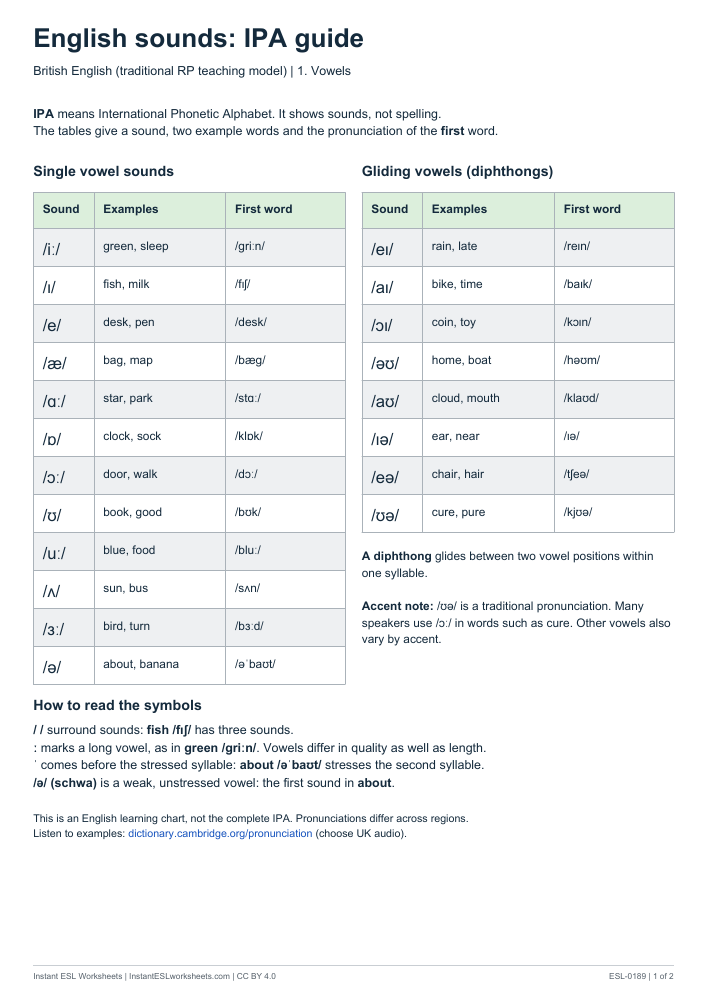
Page 1 of 2 · A4 printable PDF
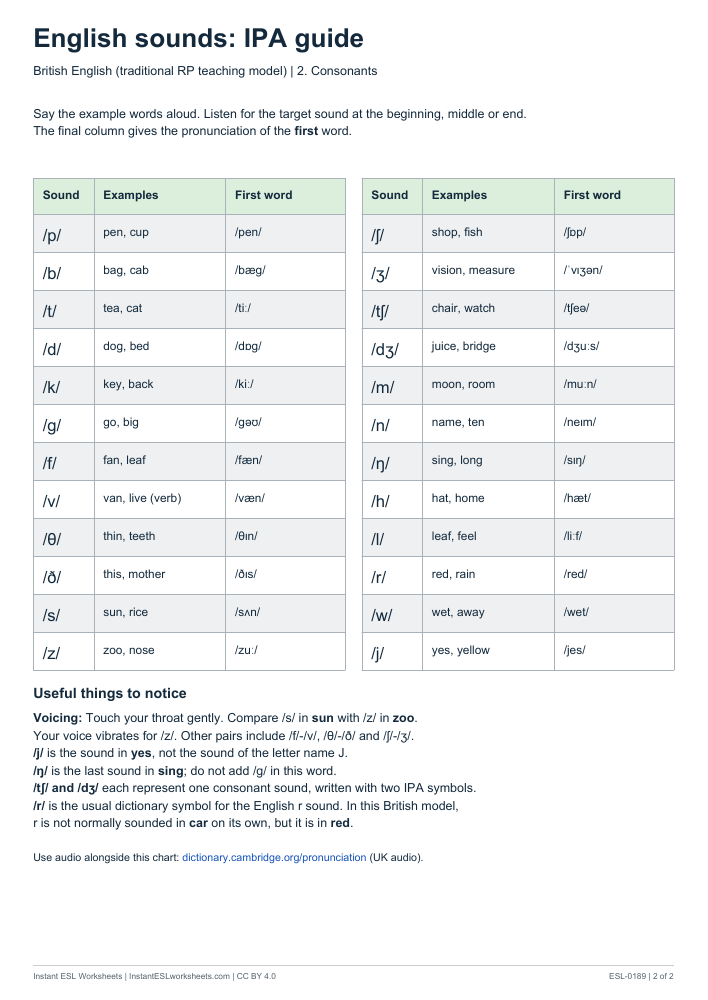
Page 2 of 2 · A4 printable PDF
A simple way to teach it
Before the lesson
Use spoken models or dictionary UK audio alongside the chart; the PDF itself contains no audio. Explain that IPA represents sounds rather than English spelling and that regional pronunciations vary.
- Choose a small set of sounds and compare the example words with the transcribed first word.
- Read the notes on vowel length, stress and schwa, then locate an example such as about.
- Use the consonant notes to compare voicing and distinguish /j/ in yes from the letter name J.
Support and extension
Focus on a few useful contrasts, not memorising the entire chart. Extend by locating a sound in a dictionary transcription. Accept accent variation, including the traditional /ʊə/ note and non-rhotic model; the chart is not the complete IPA or a claim that every British speaker uses these pronunciations.
Suggested approach. Adjust the pace and number of questions to suit your class.