Environment Vocabulary: Gap-Fill
Build confidence with 15 useful environment words and phrases. Complete contextual gap-fill sentences, then discuss the topic with a partner. Includes a full-sentence answer key.
What’s in the worksheet?
- 15-word vocabulary bank
- 15 contextual gap-fill sentences
- Three partner-discussion questions
- Full-sentence answer key on page 2
Use 15 B1 environmental words in a once-only gap-fill, then discuss three questions about concerns, daily changes and responsibility. Page 2 provides the intended sentence answers.
Worksheet preview
Open PDF ↗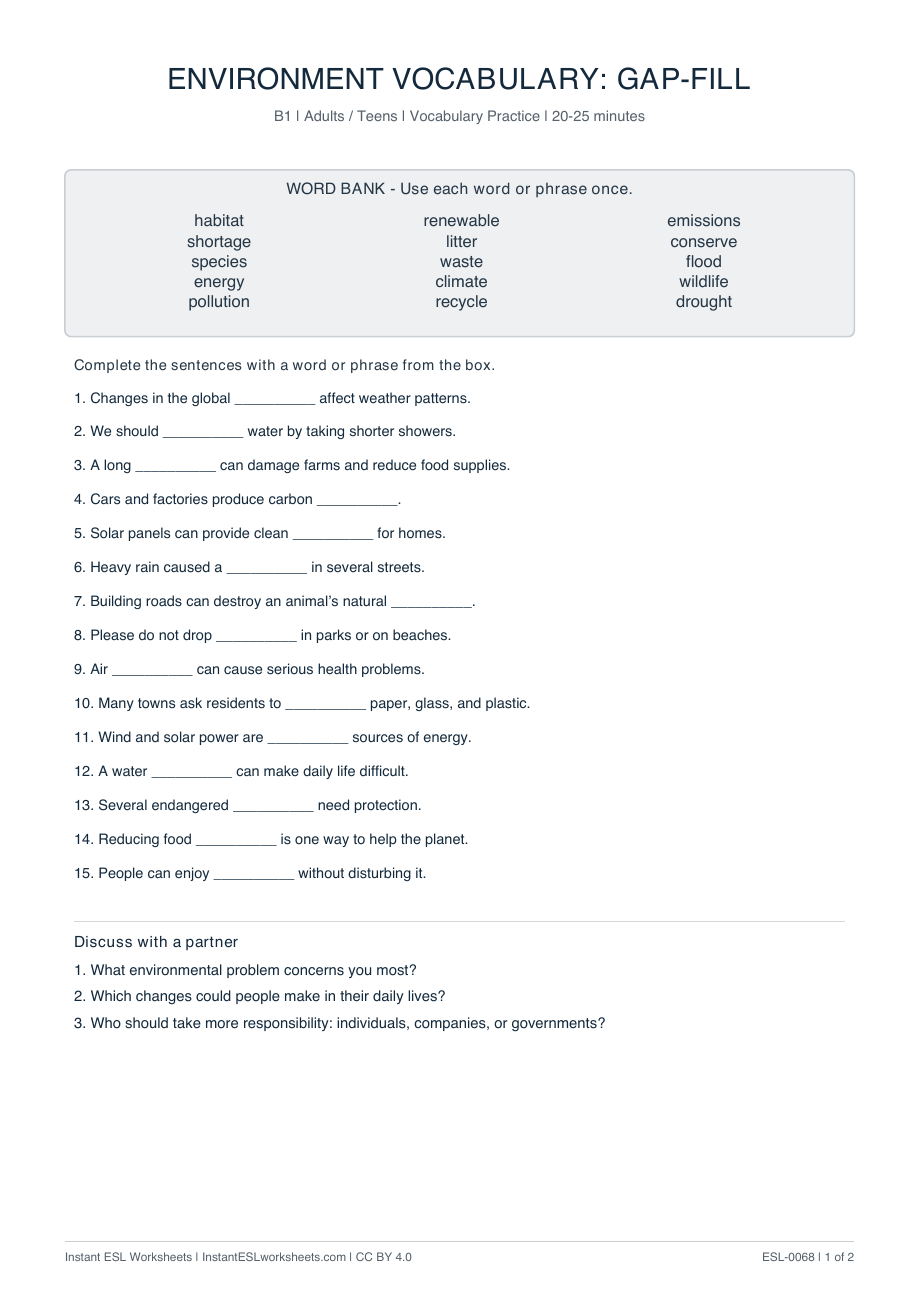
Page 1 of 2 · A4 printable PDF
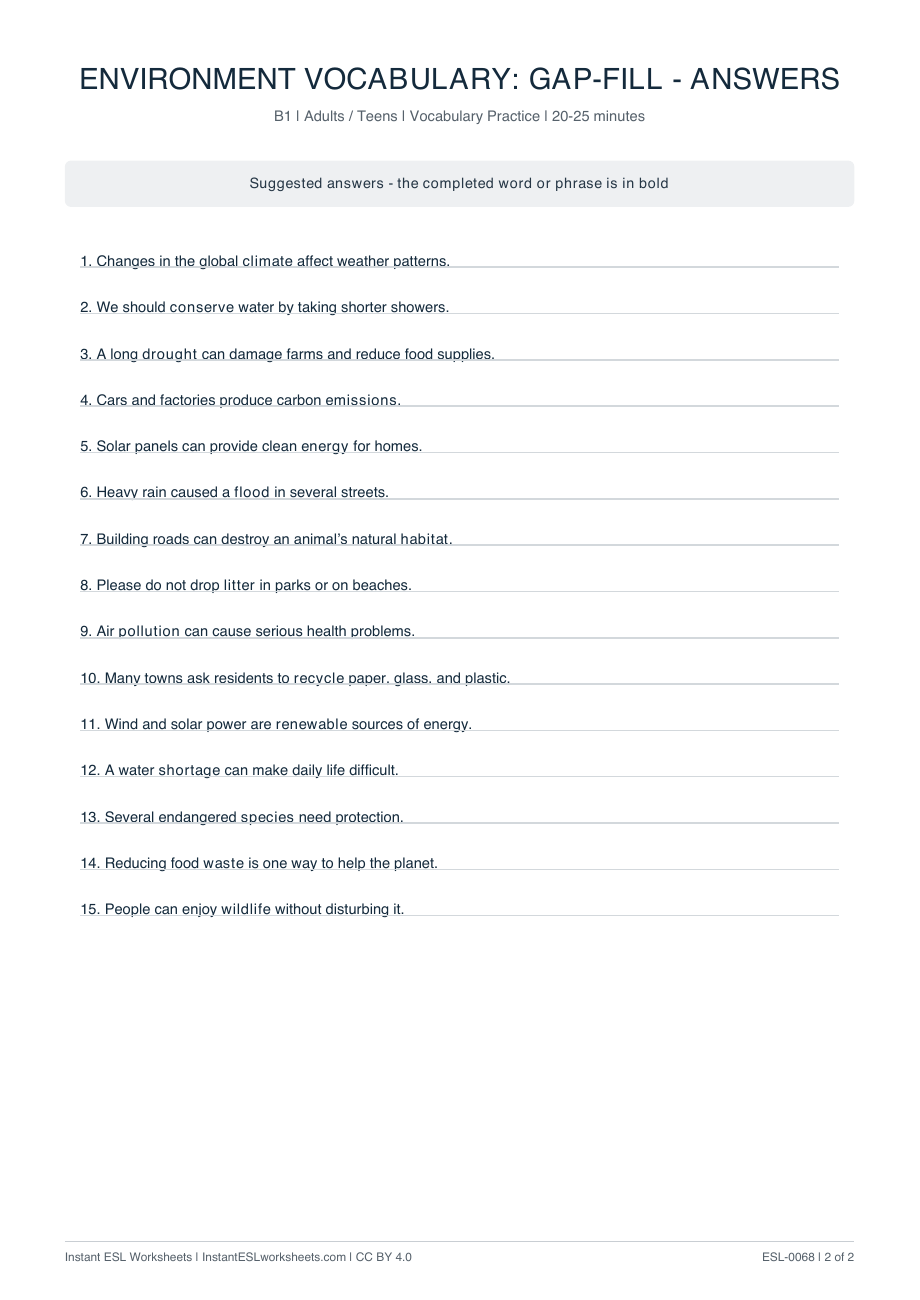
Page 2 of 2 · Answer key · A4 printable PDF
A simple way to teach it
Before the lesson
Review habitat, wildlife and species, and distinguish drought, flood and shortage. Use the examples to establish vocabulary rather than requiring technical environmental knowledge or a particular political opinion.
- Read the word bank and attempt the sentences. Use grammar clues to distinguish actions such as conserve and recycle from nouns such as pollution and waste.
- Compare and check the key, explaining why drought and water shortage fit different sentences. Practise useful combinations such as renewable energy and carbon emissions.
- Discuss the three printed questions with reasons and examples. Encourage a response to a partner's idea rather than simply listing environmental problems.
Support and extension
For support, sort words into actions, problems and nature terms. For an extension, write a short proposal using selected vocabulary as an optional task. Respect different views about individual, company and government responsibility. The gap-fill has constrained answers; opinions are not marked against a fixed key or judged by agreement with the teacher.
Suggested approach. Adjust the pace and number of questions to suit your class.