Food and Cooking Vocabulary: Gap-Fill
Build confidence with 15 useful food and cooking words and phrases. Complete contextual gap-fill sentences, then discuss the topic with a partner. Includes a full-sentence answer key.
What’s in the worksheet?
- 15-word vocabulary bank
- 15 contextual gap-fill sentences
- Three partner-discussion questions
- Full-sentence answer key on page 2
Practise 15 B1 food and cooking terms in a once-only gap-fill, followed by three discussion questions. The key completes each sentence, while the speaking prompts invite personal or imagined examples.
Worksheet preview
Open PDF ↗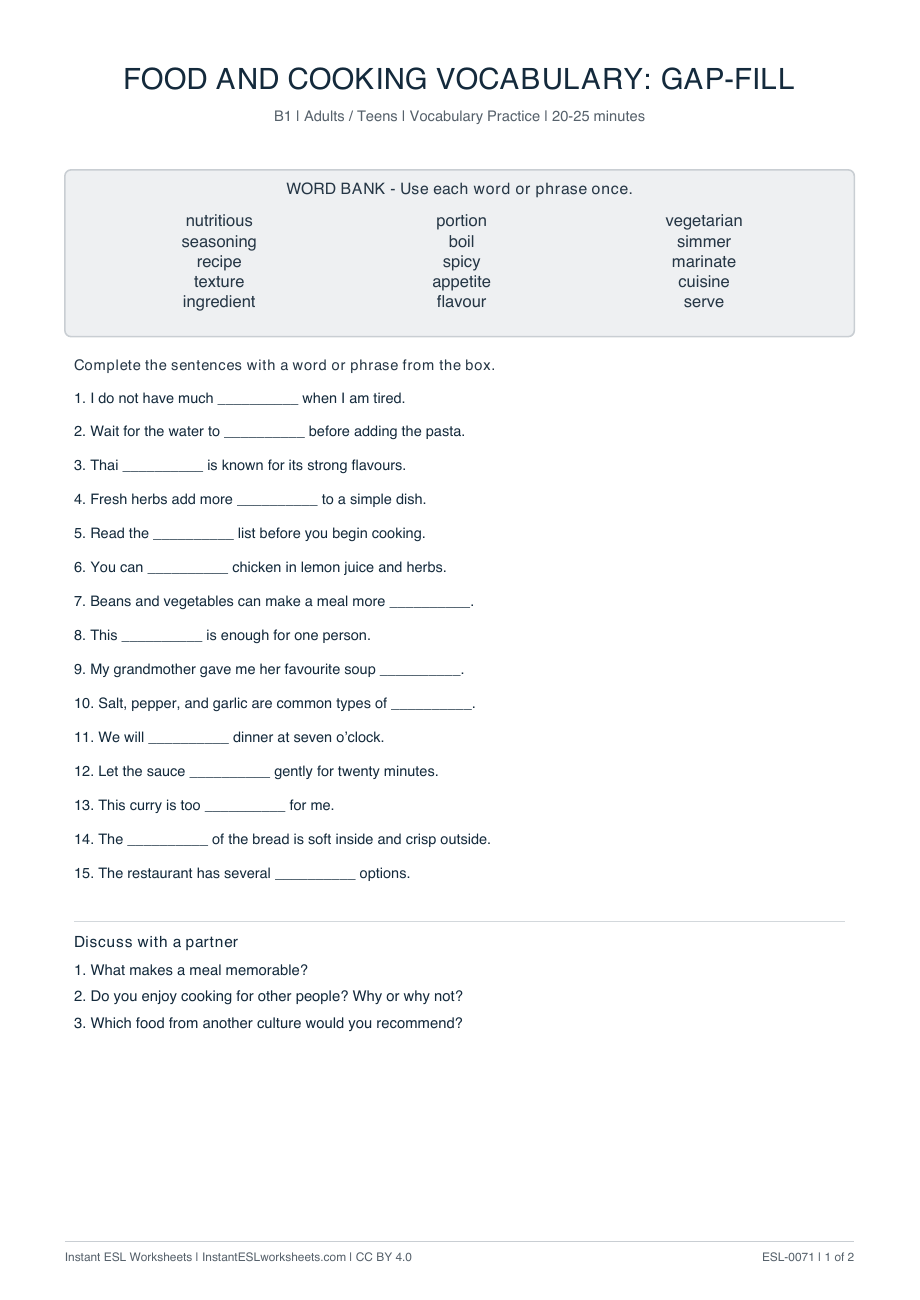
Page 1 of 2 · A4 printable PDF
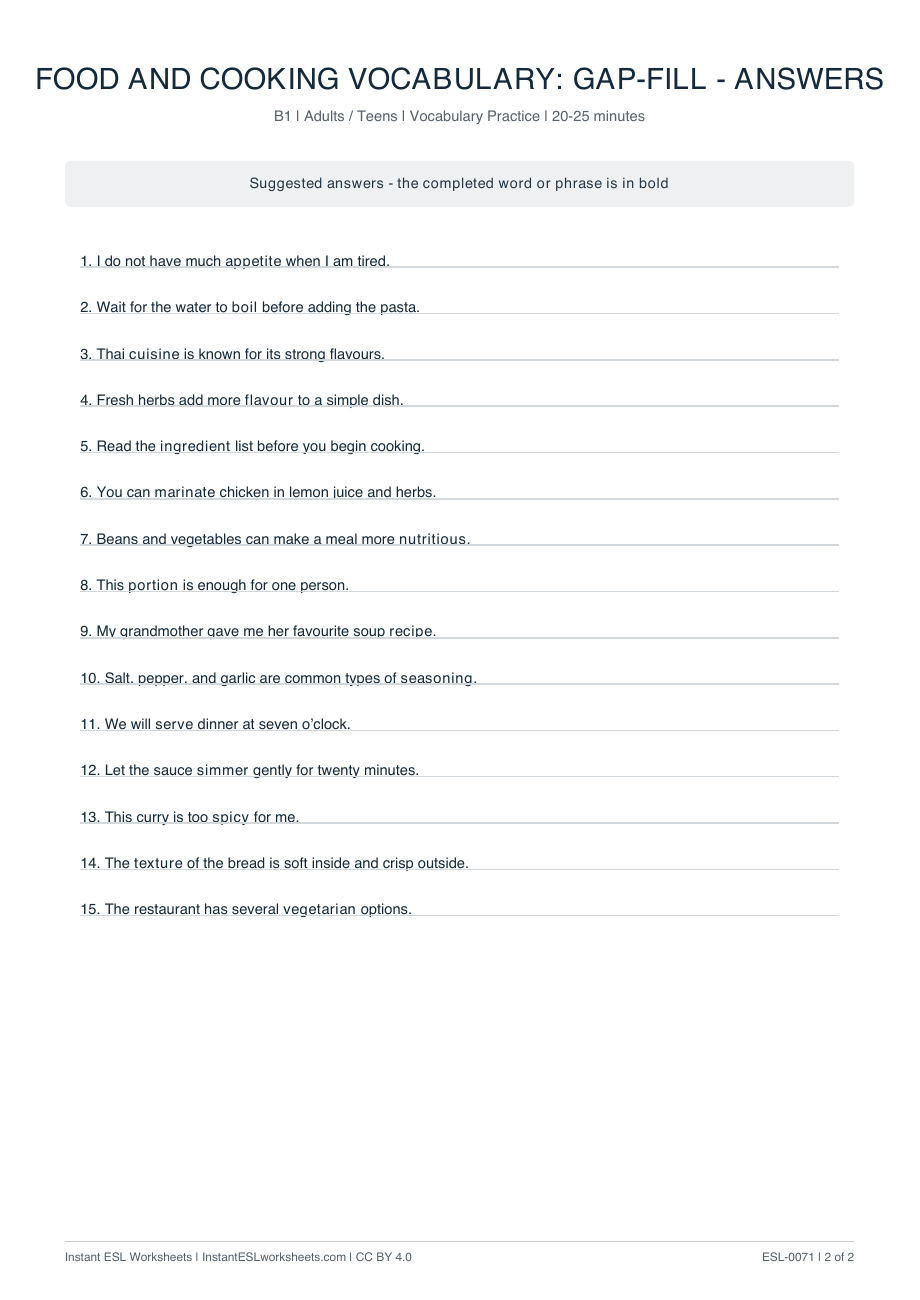
Page 2 of 2 · Answer key · A4 printable PDF
A simple way to teach it
Before the lesson
Review boil versus simmer, flavour versus texture, and ingredient versus recipe. Keep page 2 for checking. No cooking or tasting is required, and learners need not disclose dietary restrictions.
- Read the word bank and complete the sentences, using both grammar and meaning clues.
- Check with a partner and the key. Revisit ingredient list, vegetarian options and serve dinner as useful combinations.
- Discuss memorable meals, cooking for others and a food recommendation. Ask for reasons rather than a list of favourite dishes.
Support and extension
For support, group actions and descriptive words separately. For an extension, describe an invented dish using selected terms. Accept different tastes and cultural examples without judging them. Gap answers are constrained by the bank; discussion has no fixed key. The sentences are language examples, not a full recipe or food-safety instructions.
Suggested approach. Adjust the pace and number of questions to suit your class.